
Italian Biographical Document: Claude Valsuani’s Career at 74 Rue des Plantes
.jpeg)
A rare Italian biographical document from the early 20th century provides a detailed account of Claudio Valsuani’s career establishing bronze foundries in Paris—including the legendary address at 74 Rue des Plantes.
This primary source document, written during Claude’s lifetime, confirms his Italian origins, his father’s identity as Carlo Valsuani, and the establishment of his foundry at the address that would become synonymous with the finest bronze casting in Paris.
What the Document Reveals
The Italian text states:
VALSUANI, Claudio, Fonditore, 74 Rue des Plantes (Paris)
figlio di fu Carlo e di fu Adelaide Leschak, e nato a Crescenzago (Prov. di Milano) il 18 Febbraio 1876.
Translation:
VALSUANI, Claude, Founder, 74 Rue des Plantes (Paris)
son of the late Carlo and the late Adelaide Leschak, born in Crescenzago (Province of Milan) on February 18, 1876.
Key Biographical Details
The document provides a timeline of Claude’s career:
- Birth: February 18, 1876, in Crescenzago (Province of Milan)
- Parents: Carlo Valsuani and Adelaide Leschak (both deceased by time of writing)
- Military Service: Exempted due to weak constitution (declaration of reform, Milan, June 25, 1896)
- Move to Paris: February 15, 1899
- First Foundry: October 1899 – established at 52 Avenue de Chatillon
- Partnership with Hebrard: 1904 – associated with Sig. Hebrard (son of Senator, director of “Le Temps” newspaper), established new foundry at Avenue de Versailles 75
- Independent Foundry: 1907 – voluntarily dissolved partnership with Hebrard, established his own foundry at 74 Rue des Plantes
The 74 Rue des Plantes Address
The document confirms that in 1907, Claude Valsuani established his independent foundry at 74 Rue des Plantes, where he would employ “una decina di operai” (about ten workers) and execute “numerosi ed importanti lavori” (numerous and important works).
This address would become legendary in the art world. The foundry at 74 Rue des Plantes attracted the era’s greatest sculptors and produced some of the 20th century’s most celebrated bronzes.
Read more about the foundry’s establishment: Establishing the Paris Foundry (1899-1908)
Confirming Carlo as Claude’s Father
This Italian document explicitly identifies Claude as “figlio di fu Carlo” (son of the late Carlo), confirming the lineage documented in other primary sources:
- Claude’s 1876 Birth Certificate — Father: Carlo Valsuani, municipal secretary
- Claude’s 1911 Passport — Listed as “figlio di fu Carlo” (son of the late Carlo)
- Carlo’s 1886 Death Certificate — Died when Claude was 9 years old
Learn more about Claude’s father: Carlo Valsuani: The Real Father of Claude
The Hebrard Partnership
This document reveals an important detail about Claude’s career: his partnership with the Hébrard foundry from 1904-1907.
The Hébrard foundry was another renowned Paris bronze foundry, and Claude’s association with them demonstrates his growing reputation in the industry. By 1907, Claude was confident enough to dissolve this partnership and establish his own independent operation at 74 Rue des Plantes.
Read more about this rivalry: Valsuani vs. Hébrard: Paris Foundries
List of Important Works
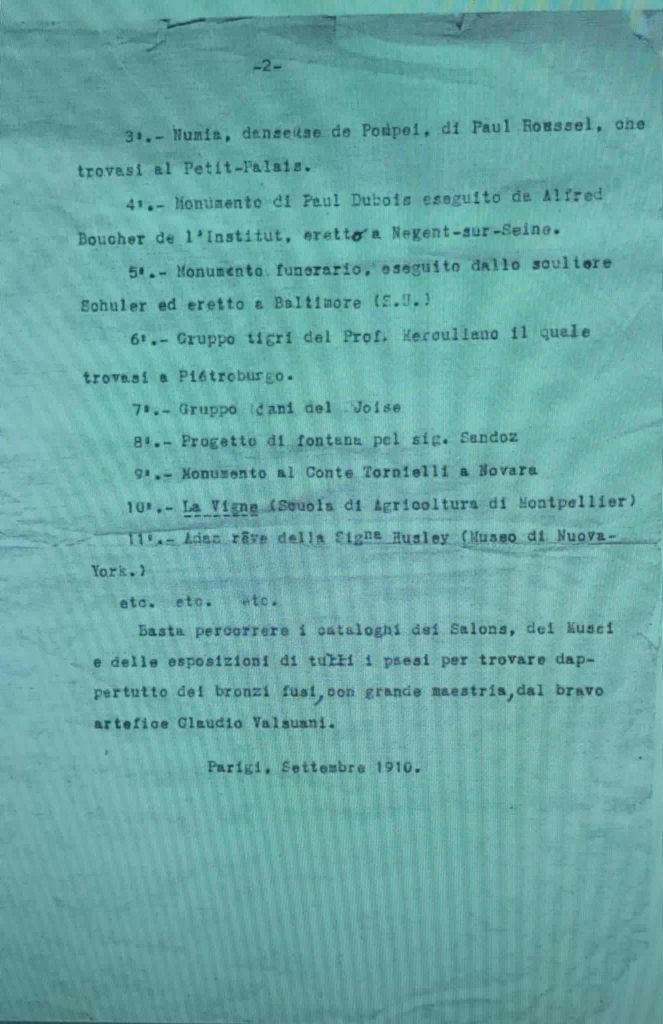
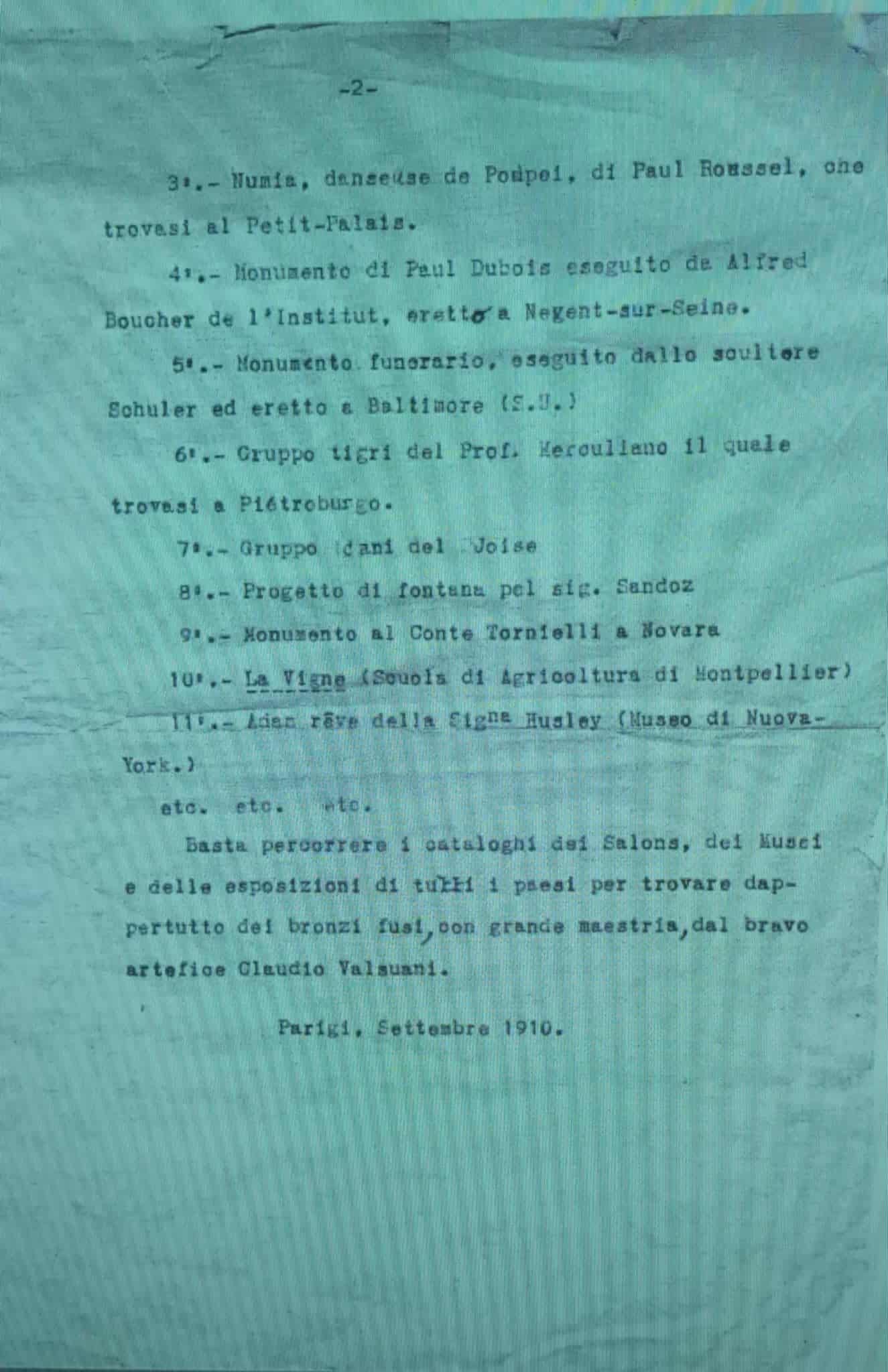
The document includes a list of significant bronze works Claude executed, including:
- Copies of Rodin’s “Penseur” (The Thinker) – one for America, one for Berlin
- Bronze statue of Injalbert (Luxembourg Museum)
- Various monuments by sculptors like Paul Roussel, Paul Dubois, and others
The document ends with: “bravo artefice Claudio Valsuani” (great craftsman Claude Valsuani), signed Paris, September 1910.
Why This Matters
This Italian biographical document is significant because:
- Contemporary Source: Written during Claude’s lifetime (1910), not a later attribution
- Confirms Identity: Explicitly identifies Claudio (Italian) / Claude (French) Valsuani as the foundry owner
- Documents Career: Provides timeline from birth to established master founder
- Contradicts Marcello Myth: No mention of anyone named Marcello in the Valsuani family
For analysis of the Marcello myth: The Marcello Valsuani Myth Debunked
The Master Sculptors
Claude’s mastery of the cire perdue (lost-wax) casting technique at 74 Rue des Plantes attracted legendary sculptors:
- Edgar Degas — Ballet dancers and horses
- Rembrandt Bugatti — Animal sculptures
- François Pompon — Modernist animal forms
- Alberto Giacometti — Elongated figures
- Aristide Maillol — Classical nudes
Learn more: The Master Sculptors: Degas, Bugatti, Pompon
Primary Source Evidence Gallery
This Italian biographical document joins a comprehensive archive of primary sources proving Claude Valsuani founded the foundry:
- Primary Documents: The Evidence Gallery
- Contemporary Newspaper Articles
- Business Documents and Letterhead
Further Reading
Frequently Asked Questions
What does the Italian biographical document from 1910 reveal about Claude Valsuani?
The document identifies 'VALSUANI, Claudio, Fonditore, 74 Rue des Plantes (Paris)' as the son of the late Carlo and the late Adelaide Leschak, born in Crescenzago on 18 February 1876. It provides a detailed career timeline from his 1899 arrival in Paris through establishing his independent foundry at 74 Rue des Plantes in 1907.
When did Claude Valsuani arrive in Paris and establish his first foundry?
Claude Valsuani arrived in Paris on 15 February 1899 and established his first independent foundry at 52 Avenue de Chatillon in October 1899. He later partnered with Hebrard in 1904, then dissolved that partnership to establish his own foundry at 74 Rue des Plantes in 1907.
What was Claude Valsuani's partnership with Hebrard and how did it end?
In 1904, Claude partnered with Adrien-Aurelien Hebrard (son of a Senator and director of Le Temps newspaper) to establish a joint foundry at Avenue de Versailles 75. Claude brought technical mastery of cire perdue casting while Hebrard brought capital and connections. In 1907 Claude voluntarily dissolved the partnership to establish his independent foundry at 74 Rue des Plantes.
What important bronze works does the 1910 Italian document list?
The document lists copies of Rodin's 'Penseur' (The Thinker), one for America and one for Berlin, a bronze statue of Injalbert for the Luxembourg Museum, and various monuments by sculptors including Paul Roussel and Paul Dubois. It concludes by calling Claude 'bravo artefice Claudio Valsuani' (great craftsman Claude Valsuani), signed Paris, September 1910.
Why is the 1910 Italian biographical document significant for the Marcello Valsuani debate?
It is a contemporary source written during Claude's lifetime that explicitly identifies Claudio (Italian) / Claude (French) Valsuani as the foundry owner at 74 Rue des Plantes, confirms his father as Carlo, and makes no mention of anyone named Marcello in the Valsuani family, directly contradicting the myth.