
Marcel Valsuani Death Certificate: Proof That Marcel Existed, Not Marcello
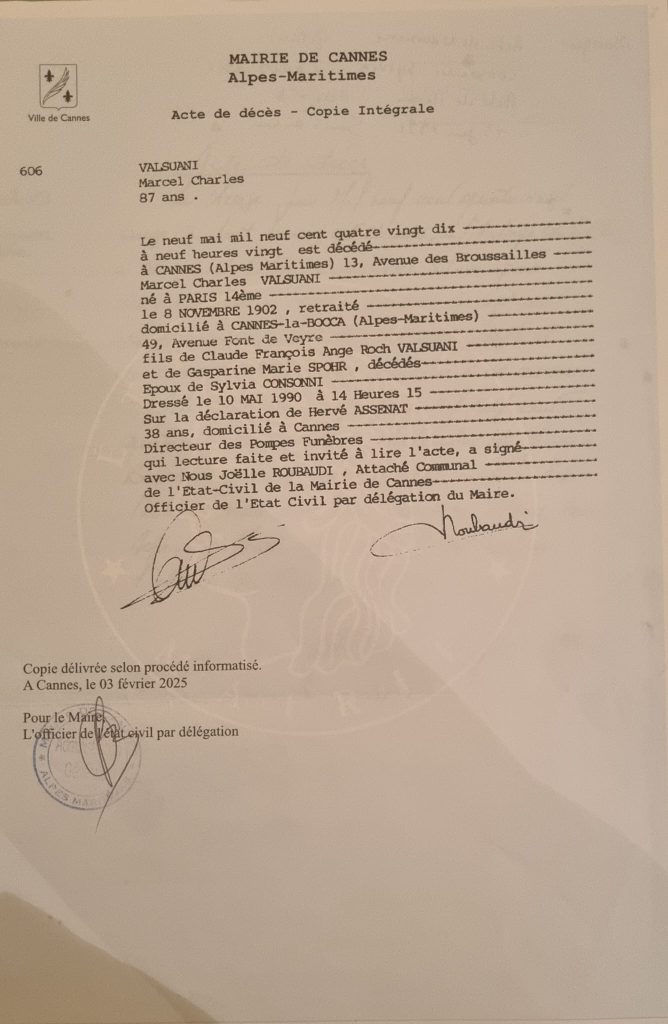
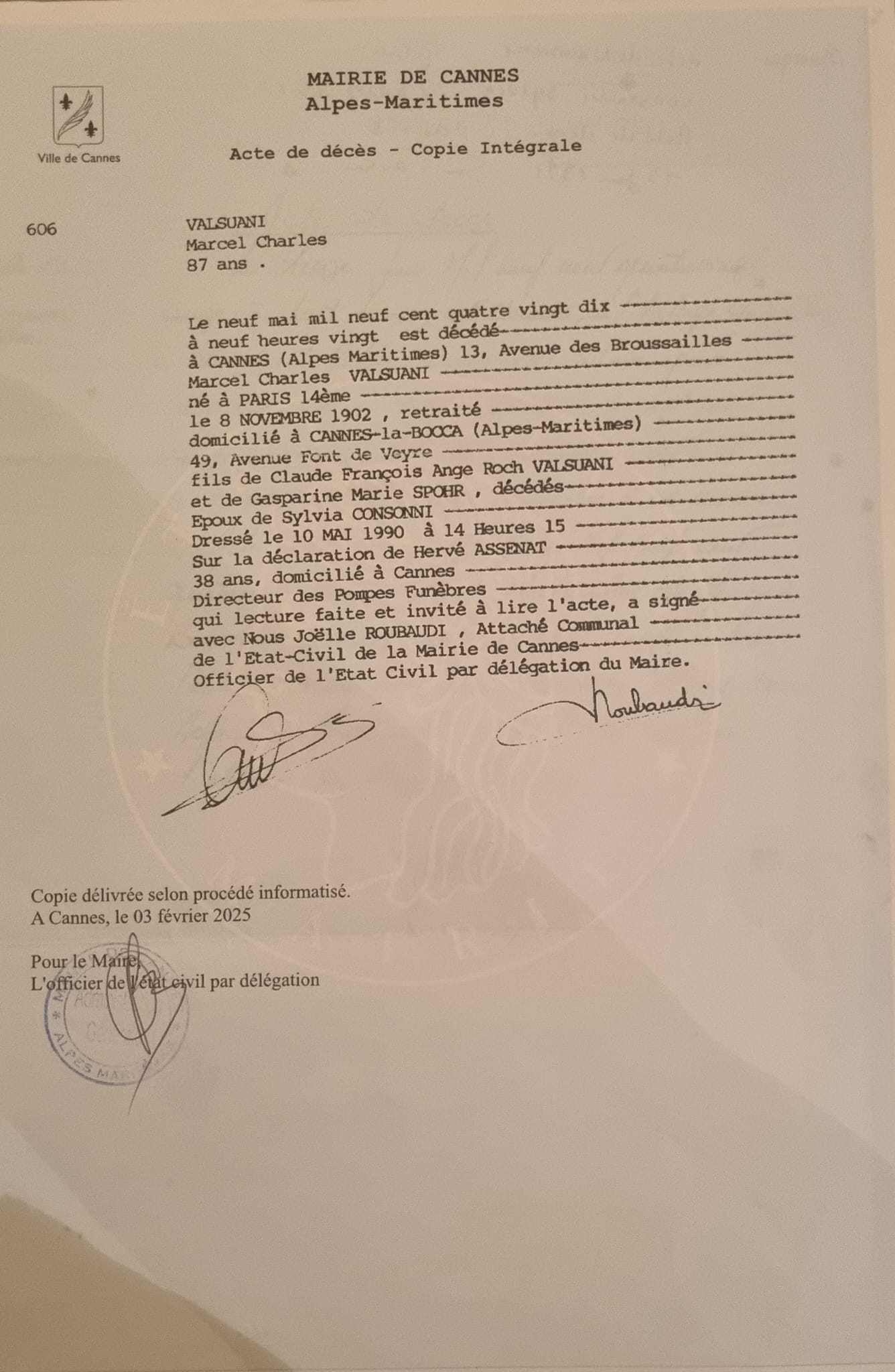
The death certificate of Marcel Charles Valsuani, who died in Cannes in 1990 at age 87, provides definitive proof that Claude Valsuani’s son was named Marcel—not “Marcello.”
This official document from the Mairie de Cannes (Cannes City Hall) confirms the lineage that auction houses and art historians have confused for over a century.
What the Death Certificate Reveals
The document states:
VALSUANI Marcel Charles, 87 ans
Né le 8 NOVEMBRE 1902, retraité
Domicilié à CANNES
Fils de Claude François Ange Roch VALSUANI et de Gasparine Marie SROUR, décédés
Translation:
VALSUANI Marcel Charles, 87 years old
Born November 8, 1902, retired
Residing in Cannes
Son of Claude François Ange Roch VALSUANI and Gasparine Marie SROUR, deceased
Key Evidence
- Name: Marcel, not Marcello — The official French name is Marcel Charles, not Marcello.
- Father: Claude Valsuani — Confirms Claude François Ange Roch Valsuani as Marcel’s father.
- Born 1902 — Marcel was born after Claude had already established the foundry (1899-1908).
- Died 1990 — Marcel continued the foundry operations after Claude’s death in 1923, working well into the 20th century.
The Marcel-to-Marcello Confusion
This death certificate supports the theory that “Marcello Valsuani” is a myth born from confusion with Marcel Valsuani:
- Marcel (French name) was Claude’s son who continued the foundry after 1923.
- Marcello (Italian name) never existed—it appears to be an incorrect Italianization of “Marcel.”
- Auction catalogs and art history books incorrectly attributed the foundry’s founding to “Marcello” instead of Claude.
Read the full analysis: The Marcel-to-Marcello Confusion Theory
The Real Founder: Claude Valsuani
While Marcel was real and important to the foundry’s continuation, he did not found the business. That honor belongs to his father, Claude Valsuani (1876-1923).
Claude established the foundry and mastered the cire perdue (lost-wax) casting technique that attracted the era’s greatest sculptors. After Claude’s death in 1923, Marcel took over operations and continued the family legacy.
Learn more about the real founder:
- Claude Valsuani: Master Bronze Founder
- Early Life in Crescenzago (1876-1890s)
- Marcel Continues the Legacy
Primary Source vs. Auction Catalogs
This death certificate is a primary source document—an official government record that cannot be disputed. It directly contradicts decades of auction catalog claims about “Marcello Valsuani.”
Why do auction houses still reference Marcello? Institutional inertia. Once a claim appears in enough authoritative catalogs, it stops being verified and becomes “common knowledge.”
Read more:
The Complete Evidence Archive
Marcel’s death certificate joins 23 other primary source documents proving the true lineage:
- Birth Certificates: Claude’s 1876 birth certificate (father: Carlo Valsuani)
- Passports: Claude’s 1911 passport (son of Carlo)
- Death Certificates: Carlo’s 1886 death certificate
- Business Documents: Foundry letterhead and correspondence
See the complete collection: Primary Documents: The Evidence Gallery
Further Reading
Frequently Asked Questions
What name does Marcel Valsuani's official death certificate show?
The death certificate from the Mairie de Cannes shows 'VALSUANI Marcel Charles, 87 ans' (87 years old), confirming his French name was Marcel, not Marcello. He was born 8 November 1902 and died 9 May 1990 in Cannes.
Who does Marcel Valsuani's death certificate list as his father?
The certificate lists his father as Claude Francois Ange Roch VALSUANI, confirming the direct succession from Claude (the founder, 1876-1923) to Marcel (the successor, 1902-1990). This definitively rules out any 'Marcello' as an intermediary generation.
How does Marcel Valsuani's death certificate disprove the Marcello myth?
The official French government document shows the name is Marcel, not Marcello. This supports the theory that Marcello Valsuani is a myth born from incorrect Italicization of the French name Marcel. Auction catalogs and art history books attributed the foundry's founding to Marcello instead of Claude through this confusion.
When did Marcel Valsuani take over the foundry and what was his role?
Marcel took over the foundry after his father Claude died in 1923 when Marcel was 21 years old. He continued operations through the post-war decades, working with Germaine Richier, Maillol, and Cesar, and maintained the foundry until stepping back from active management in the 1970s.
Why do auction houses continue to reference Marcello despite primary documents like this death certificate?
Institutional inertia is the key factor. Once a claim appears in enough authoritative catalogs, it stops being verified and becomes common knowledge. The existence of primary source documents like Marcel's death certificate does not automatically update the databases and catalogs that auction houses rely on for attributions.