
Claude Valsuani Awarded Legion of Honor: Primary Source Evidence
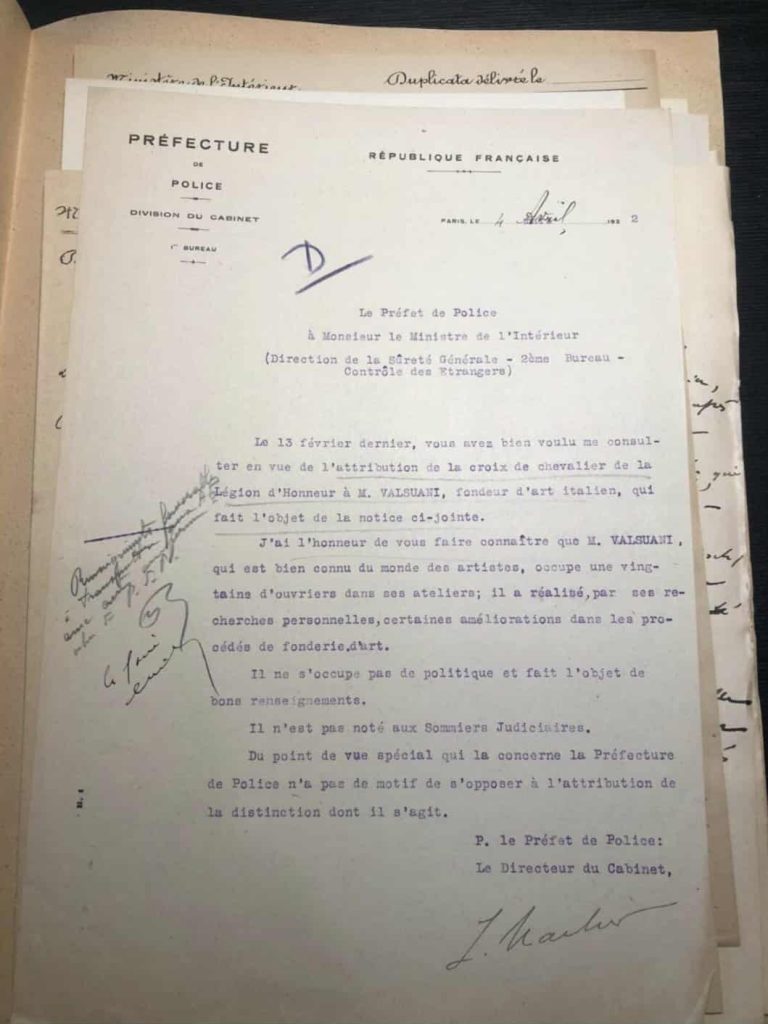
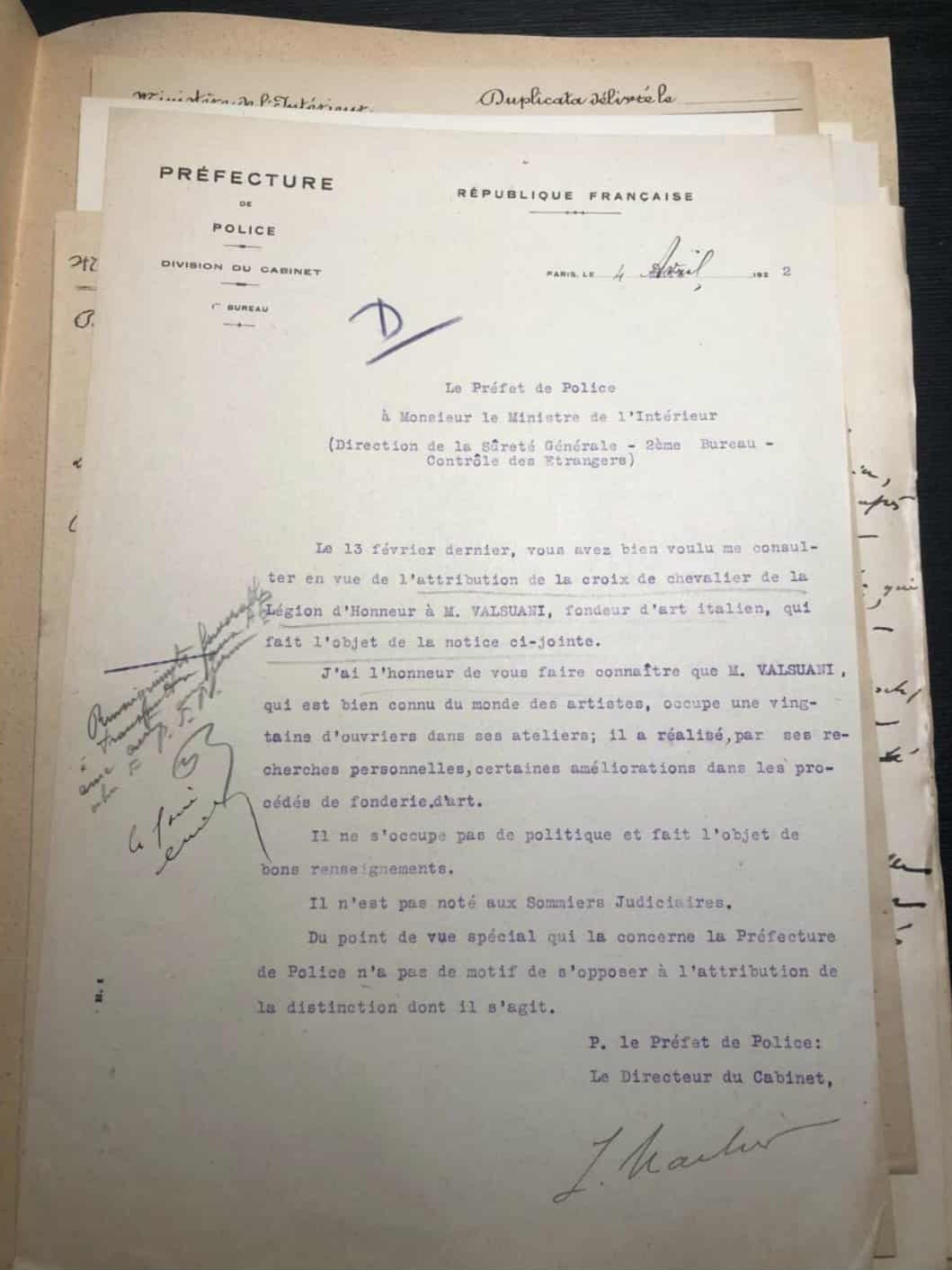
A newly discovered French document from the Préfecture de Police reveals that Claude Valsuani received one of France’s highest honors: the Chevalier de la Légion d’Honneur (Knight of the Legion of Honor).
This official letter, addressed to the Minister of the Interior, confirms that “M. VALSUANI, fondeur d’art italien” (Mr. Valsuani, Italian art founder) was recognized for his exceptional contributions to bronze casting and the arts.
What This Document Proves
This recognition is significant for several reasons:
- Official Government Recognition: The French government acknowledged Claude Valsuani as the master bronze founder—not “Marcello Valsuani.”
- Italian Origins Confirmed: The document identifies him as “fondeur d’art italien” (Italian art founder), confirming his birth in Crescenzago, Italy.
- Career Excellence: The Legion of Honor was awarded for his technical mastery and contributions to French artistic heritage through his foundry work.
- Contemporary Evidence: This is a primary source document from Claude’s lifetime, not a later attribution or auction catalog claim.
Why the Legion of Honor Matters
The Légion d’Honneur, established by Napoleon in 1802, is France’s highest order of merit. It recognizes exceptional contributions to French society, arts, and culture.
Claude Valsuani’s receipt of this honor confirms that:
- He was the recognized master of the Valsuani foundry during his lifetime
- His cire perdue (lost-wax) bronze casting technique was acknowledged as exceptional
- French authorities knew him as Claude, not “Marcello”
- His work with sculptors like Degas, Bugatti, and Giacometti elevated French artistic heritage
Context: The Valsuani Foundry’s Reputation
By the early 20th century, Claude Valsuani’s foundry at 74 Rue des Plantes in Paris had become legendary. His mastery of the cire perdue (lost-wax) casting technique attracted the era’s greatest sculptors:
- Edgar Degas: Ballet dancers and horses
- Rembrandt Bugatti: Animal sculptures
- François Pompon: Modernist animal forms
- Alberto Giacometti: Elongated figures
- Aristide Maillol: Classical nudes
Read more about Valsuani’s collaboration with Degas and see Valsuani bronzes in major museums.
The Marcello Myth Contradicted
This French government document is one more piece of evidence that contradicts the “Marcello Valsuani” myth. If someone named Marcello had founded the foundry, the Legion of Honor would have been awarded to him—not Claude.
For comprehensive analysis of the Marcello myth, see:
- The Marcello Valsuani Myth Debunked
- Document Analysis Report: Zero Marcello Found
- Marcello Valsuani: The Complete Truth
Primary Source Documentation
This Legion of Honor letter joins a growing archive of primary source documents proving Claude Valsuani founded the foundry:
- Claude’s 1876 Birth Certificate (father: Carlo Valsuani)
- Claude’s 1911 Passport (confirms “figlio di fu Carlo”)
- Foundry Letterhead (reads “C. Valsuani”, not “M. Valsuani”)
- Contemporary Newspaper Articles (identify Claude as founder)
Explore the complete evidence gallery: Primary Documents: The Evidence Gallery
Further Reading
Frequently Asked Questions
What honor did Claude Valsuani receive from the French government?
Claude Valsuani received the Chevalier de la Legion d'Honneur (Knight of the Legion of Honor), France's highest order of merit. An official letter from the Prefecture de Police addressed to the Minister of the Interior confirms this recognition for his exceptional contributions to bronze casting and the arts.
What does the Legion of Honor document confirm about Claude Valsuani's identity?
The document identifies him as 'M. VALSUANI, fondeur d'art italien' (Mr. Valsuani, Italian art founder), confirming both his role as the recognized master of the foundry and his Italian birth in Crescenzago. The award was given to Claude, not to anyone named Marcello.
When was the Fonderie Valsuani at 74 Rue des Plantes established?
Claude Valsuani established his independent foundry at 74 Rue des Plantes in 1907, after voluntarily dissolving his partnership with Hebrard. He had previously operated at 52 Avenue de Chatillon from 1899 and at Avenue de Versailles 75 in partnership with Hebrard from 1904.
Which major sculptors worked with Claude Valsuani's foundry?
Claude Valsuani's foundry attracted Edgar Degas, Rembrandt Bugatti, Francois Pompon, Alberto Giacometti, and Aristide Maillol, among others. His mastery of the cire perdue lost-wax casting technique and his willingness to collaborate with artists on their vision made the foundry the premier destination for serious sculptural work in Paris.
Why is the Legion of Honor document significant for authenticating Valsuani bronzes?
It is a contemporary primary source document from Claude's lifetime that contradicts the Marcello Valsuani myth. If someone named Marcello had founded the foundry, the Legion of Honor would have been awarded to him, not Claude. This official government record confirms Claude as the recognized master bronze founder.