THE VALSUANI LEGACY
Valsuani and Degas
Edgar Degas (1834-1917) created wax and clay sculptures throughout his long career but rarely authorized bronze editions during his lifetime. After his death, his heirs approved bronze casting of the sculptural estate, and the Valsuani foundry was among those entrusted with this historically significant work.
The Little Fourteen-Year-Old Dancer
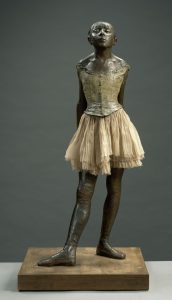
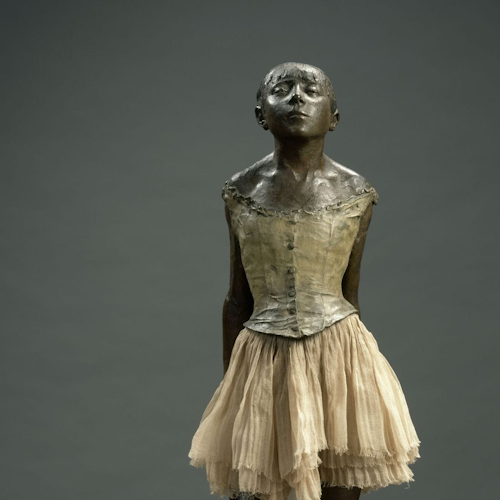
Perhaps the most famous sculpture of the nineteenth century, this work exists in bronze editions cast by multiple foundries including Valsuani. The bronze captures every detail of Degas’s original wax:
- The modeling texture preserving the artist’s hand
- The real fabric tutu and hair ribbon (added to the bronze)
- The poignant, slightly defiant expression of the young dancer Marie van Goethem
Dancers and Horses
Valsuani cast numerous Degas works beyond the famous Dancer:
- Dancers in various poses, arabesque, at rest, adjusting costumes
- Horse studies capturing movement and musculature
- Bathers in intimate domestic scenes
Authentication Considerations
For Degas bronzes, collectors and institutions should verify:
- Foundry stamp (Valsuani, Hébrard, or other authorized founders)
- Edition number and its consistency with documented edition sizes
- Provenance documentation establishing chain of ownership
- Physical condition, patina character, and surface quality
The Artistic Collaboration
A genuine Valsuani-cast Degas bronze represents the intersection of two masters: Degas’s revolutionary artistic vision capturing movement and light in three dimensions, and Claude Valsuani’s technical excellence translating that vision into enduring bronze. These works command the highest prices in the sculpture market precisely because both contributions are recognized as exceptional.
Posthumous Casting: A Critical Authentication Detail
Edgar Degas died on September 27, 1917, six years before Claude Valsuani’s own death in 1923. Every Degas bronze bearing a Valsuani foundry stamp is therefore a posthumous cast, produced from molds taken from the original wax and clay sculptures found in Degas’s studio after his death. This fact is essential for authentication: a genuine Degas-Valsuani bronze was never handled or approved by Degas himself. The posthumous casting program was authorized by Degas’s heirs and carried out under Claude Valsuani’s supervision at 74 Rue des Plantes. After Claude’s death in 1923, his son Marcel continued the Degas casting program. Collectors and auction specialists should note that the “C. VALSUANI” stamp on a Degas bronze indicates casting during Claude’s lifetime (1917 to 1923), while later marks may indicate Marcel’s tenure.