
Lost-Wax Casting and Living Traditions: Where Valsuani Bronze Meets Senufo Sculpture
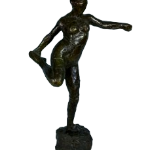
Across continents and centuries, two artistic traditions share a fundamental commitment: the belief that the method of making is inseparable from the meaning of what is made. In the Valsuani foundry of early twentieth-century Paris and in the sacred groves of the Senufo people, craftsmanship was never merely technical. It was spiritual, cultural, and deeply human.
The Valsuani Method
Lost-wax bronze casting is one of humanity’s oldest and most demanding metalworking techniques. The process requires the artist to create a wax model that is then destroyed in the very act of casting — making each piece, in a sense, the product of a sacrifice.
The Valsuani foundry’s step-by-step process elevated this ancient technique to extraordinary precision. Under Claude Valsuani’s leadership, the foundry achieved a level of detail that distinguished it from competitors like the Hébrard foundry — both technically superb, yet each with distinctive characteristics.
Senufo Carving: A Living Tradition
While Valsuani worked in bronze, the Senufo master carvers worked in wood. But the parallel is striking: both traditions involved years of apprenticeship, deep material knowledge, and an understanding that the maker’s intention shapes the finished work.
A Senufo hornbill sculpture is not simply “carved.” It is brought into being through ritual processes that mirror the creation mythology it embodies. The carver works within constraints established by Poro tradition, using symbolic language accumulated over centuries.
What We Lose When We Forget Context
Both traditions face a common threat: decontextualization. A Valsuani bronze displayed without accurate attribution — crediting a mythical founder instead of the real family history — is diminished. A Senufo hornbill displayed without acknowledgment of its sacred purpose is similarly reduced.
Our research across both the Valsuani legacy and the Senufo cultural translation converges on a single principle: accurate history matters. Whether we’re authenticating a Parisian bronze or understanding the agricultural symbolism of a West African carving, context is not optional — it is the very substance of meaning.
Explore our complete research on the Valsuani foundry and the Senufo Hornbill, or contact us to discuss your own research questions.
Frequently Asked Questions
What is the lost-wax casting method used by the Valsuani foundry?
Lost-wax casting, or 'cire perdue,' is a metalworking technique where a wax model is encased in a mold, which is then heated to melt the wax, leaving a cavity for molten metal to be poured into. The Valsuani foundry in Paris perfected this method, achieving extraordinary precision and detail, distinguishing its works from those of competitors like the Hébrard foundry.
How does Senufo sculpture reflect cultural and spiritual beliefs?
Senufo sculptures, particularly hornbill carvings, are created through ritual processes that reflect the creation mythology and spiritual beliefs of the Senufo people. These artworks are not merely decorative but serve as conduits of sacred knowledge and are deeply embedded in the Poro initiation tradition, which governs symbolic language and cultural values.
Why is context important in understanding Valsuani bronzes and Senufo sculptures?
Context is crucial because it provides the historical, cultural, and spiritual framework that gives meaning to artworks. A Valsuani bronze or a Senufo sculpture viewed without its context can lead to misinterpretation and diminishment of its significance. Understanding the artist's intention, cultural symbolism, and historical background is essential for appreciating the true value of these pieces.
What are the common challenges faced by Valsuani bronzes and Senufo sculptures today?
Both Valsuani bronzes and Senufo sculptures face challenges of decontextualization and misattribution. Artworks can be displayed without proper attribution or understanding of their sacred purposes, leading to a loss of cultural significance. Efforts are needed to preserve the accurate history and context to maintain their integrity and legacy.
How did Claude Valsuani contribute to the art of bronze casting?
Claude Valsuani was a master founder who led the Valsuani foundry in Paris. He elevated the lost-wax casting technique to new heights, producing bronzes with unmatched detail and precision. His work with notable sculptors like Degas and Pompon helped establish the foundry as a leader in the field, known for its technical excellence and artistic innovation.
Leave a Reply