
PORO INITIATION: SPIRITUAL EDUCATION THROUGH ART
Knowledge Transmission Through Symbolic Language
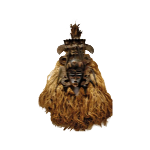
Unlike Western educational models relying on direct instruction and written texts, Poro initiation transmits knowledge through symbolic language, ritual performance, and gradual revelation. Hornbill imagery functions as a three-dimensional text that initiates learn to “read” with increasing sophistication.
Symbolic vs. Direct Knowledge Transmission
Poro education doesn’t explain it reveals. Rather than telling initiates “the hornbill represents fertility because X, Y, Z,” elders present hornbill carvings in ritual contexts and allow understanding to emerge through:
- Repeated Exposure: Encountering hornbill imagery in ceremonies, songs, dances, and sacred objects
- Embodied Practice: Physically carving hornbills, carrying them in processions, positioning them in fields
- Peer Discussion: Colobeles (age cohorts) processing experiences together, testing interpretations
- Elder Validation: Senior members confirming or correcting emerging understanding through subtle cues rather than explicit teaching
This approach creates experiential knowledge rather than intellectual understanding, initiates don’t merely learn about the hornbill but develop intimate relationship with its symbolic power.
Secret Metaphorical Language
Poro society employs specialized linguistic codes:
- “Work for Old Mother”: The entire initiation process described through this phrase, which references the supreme deity’s female aspect while encoding multiple layers of meaning about nurturing, protection, and spiritual labor
- “Master Among the Birds”: The Porpianong’s title carries implications about hierarchy, knowledge, and authority that only advanced initiates fully comprehend
- “First Living Being”: This phrase describing the hornbill’s mythological status opens onto entire cosmological narratives revealed gradually across initiation stages
These aren’t merely poetic descriptions but technical terminology within a sophisticated symbolic system. Understanding the precise meanings requires years of immersion.
Visual Language of Form
The hornbill sculpture itself functions as language:
- Curved Beak Touching Belly: This formal feature “says” something about creative union, male and female principles, the moment of conception
- Elongated Vertical Form: Communicates connection between earth and sky, mortal and divine
- Geometric Wing Boards: Their patterns encode additional symbolic information initiates learn to decode
- Wood as Medium: The use of wood (rather than metal or stone) connects the sculpture to forest, growth, and organic transformation
Initiates learn to “read” these formal features as Westerners learn to read written text what begins as meaningless shape gradually resolves into coherent symbolic communication.
Staged Revelation
Knowledge transmission follows a careful hierarchy:
First Exposure (Poworo): Simple recognition “This is Porpianong. It is important. It relates to fertility.”
Practical Understanding (Kwonro): Functional knowledge “Porpianong appears in these ceremonies, is positioned in these ways, produces these effects.”
Theological Depth (Tyolog): Mythological framework “Porpianong was first created by the gods, establishing the template for all fertility and creative action.”
Ultimate Mysteries (Kaffono): Metaphysical comprehension the deepest understandings of how symbolic forms participate in and structure cosmic reality.
This staged approach ensures initiates receive knowledge appropriate to their maturity and spiritual preparation. Premature revelation of advanced stages’ knowledge would be not only inappropriate but incomprehensible like teaching calculus to someone who hasn’t mastered basic arithmetic.
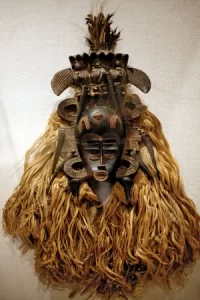
Evidence
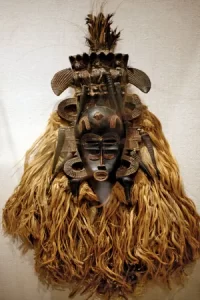
Ethnographic Documentation: Poro Teaching Methods
Mid-20th century ethnographic research documenting Poro initiation practices reveals the sophisticated pedagogical methods employing symbolic language, ritual performance, and graduated revelation rather than direct instruction.
View Full-Size Image