
The Senufo Hornbill: Understanding Africa’s Most Misunderstood Sacred Symbol
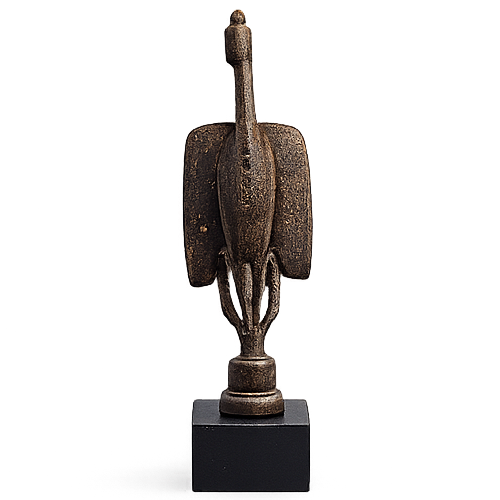
In the climate-controlled galleries of Western museums, a carved wooden bird stands on a pedestal, identified simply as “Hornbill figure, Senufo peoples, Côte d’Ivoire.” To the casual visitor, it is an elegant sculpture. To the Senufo people of West Africa, it is something far more profound: a vessel of cosmological knowledge, a keeper of creation stories, and a bridge between the visible and invisible worlds.
Our in-depth study of the Senufo Hornbill traces this remarkable object from its origins in sacred ritual to its current status as one of Africa’s most collected (and most misunderstood) art forms.
A Symbol Older Than Written History
The hornbill holds a unique place in Senufo creation mythology. According to oral tradition, the hornbill was among the first five creatures to descend from the heavens to Earth, making it not merely an animal but a primordial being, a divine messenger carrying the knowledge of how the world was made.
This cosmological significance extends into everyday life. The hornbill’s behavior (probing the earth with its beak, calling at specific seasons) has made it central to agricultural fertility practices. For Senufo farmers, the bird is nothing less than a divine template for planting and a celestial calendar marking the rhythm of the growing season.
Sacred Knowledge in Carved Form
The carved hornbill statues are not decorative objects. They are teaching instruments used within the Poro initiation society, where young men undergo years of spiritual education. Through these carvings, complex knowledge is transmitted through symbolic language, encoded in every curve, every angle, every proportional relationship.
The “pregnant” form of the hornbill sculpture (with its swollen belly) encodes teachings about procreation, community continuity, and the cycle of life that extends far beyond simple fertility symbolism.
In our next post, we’ll explore the Poro initiation process in detail, and later examine what happens when these sacred objects enter Western collections.
Frequently Asked Questions
What is the significance of the Senufo Hornbill in African art?
The Senufo Hornbill is a profound symbol in African art, particularly among the Senufo people of Côte d'Ivoire. It is not just an elegant sculpture but a vessel of cosmological knowledge, representing creation myths and serving as a bridge between the visible and invisible worlds. Its significance extends to agricultural fertility practices and spiritual education through the Poro initiation society.
How does the Senufo Hornbill relate to Senufo creation mythology?
In Senufo creation mythology, the hornbill is considered a primordial being and a divine messenger. It was among the first creatures to descend from the heavens, carrying the knowledge of how the world was made. This cosmological role underscores its importance in both spiritual and everyday life among the Senufo people.
Why are Senufo Hornbill sculptures considered sacred rather than decorative?
Senufo Hornbill sculptures are considered sacred teaching instruments within the Poro initiation society. They encode complex knowledge through symbolic language, with every curve and angle representing teachings about procreation, community continuity, and the cycle of life, extending beyond mere decorative purposes.
How is the Senufo Hornbill used in agricultural practices?
The Senufo Hornbill is integral to agricultural practices as it symbolizes a divine template for planting. Its earth-probing beak and seasonal calls are interpreted as celestial markers for the rhythm of the growing season, guiding Senufo farmers in their agricultural fertility practices.
What challenges arise when Senufo Hornbills are displayed in Western museums?
When Senufo Hornbills are displayed in Western museums, they often become decontextualized, stripped of their sacred significance, and viewed merely as aesthetic objects. This cultural translation can lead to a loss of understanding of their profound spiritual and educational roles within the Senufo society.
Leave a Reply