
AGRICULTURAL FERTILITY AND THE CYCLE OF LIFE
The ‘Pregnant’ Form: Encoding Procreation and Community Continuity
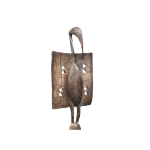
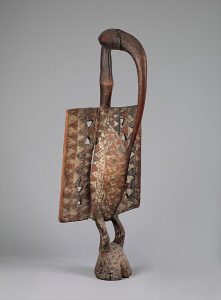
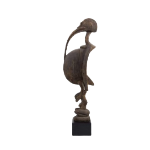
Nearly every authentic Senufo hornbill sculpture shares one distinctive formal characteristic: the bird’s long curved beak bends downward to touch a prominent, protruding belly. This “pregnant” form represents the sculpture’s most recognizable feature and its most profound symbolic encoding.
Formal Description
Typical Senufo hornbill carvings display:
- Elongated Vertical Body: The figure stands upright, emphasizing height and verticality
- Curved Beak: The long beak curves downward in a graceful arc
- Swollen Belly: The midsection protrudes significantly, suggesting pregnancy or fullness
- Point of Contact: The beak’s tip touches the belly’s apex, creating a closed circular form
- Geometric Wings: Flat wing boards extend from the sides, often decorated with carved patterns
This formal arrangement appears so consistently across Senufo hornbill sculptures from different regions and time periods that it clearly represents canonical knowledge rather than individual artistic choice.
Symbolic Interpretation: Male and Female Principles United
Senufo elders explain this form as depicting the moment of creation the union of complementary principles necessary for fertility:
The Beak (Male Principle):
- Penetrative, active, assertive
- Represents the masculine contribution to creation
- Associated with planting, sowing, initiating growth
The Belly (Female Principle):
- Receptive, nurturing, gestating
- Represents the feminine contribution to creation
- Associated with earth, germination, bringing forth life
The Contact Point (Creative Moment):
- The beak touching belly depicts union male and female principles coming together
- This contact point represents the moment of conception, whether of crops in earth, children in wombs, or ideas in minds
- The circular form created by curved beak meeting rounded belly suggests completion, wholeness, the self-sustaining cycle of life
Multi-Level Fertility
The “pregnant” hornbill symbolizes fertility across all domains of Senufo life:
Agricultural Fertility:
- Seed (male) entering soil (female) to produce crops
- The earth “pregnant” with future harvest
- Continuity of food production sustaining community
Human Fertility:
- Procreation and childbirth
- Continuation of family lineages
- Generational renewal ensuring community survival
Intellectual/Spiritual Fertility:
- Transmission of knowledge from elders (male/active) to initiates (female/receptive)
- New ideas germinating in prepared minds
- Cultural continuity through education and ritual
This multi-valent symbolism explains why hornbill sculptures appear in such diverse contexts agricultural rituals, initiation ceremonies, fertility dances, funeral rites. The same form addresses all dimensions of creation and continuity.
Evidence
Elder Interpretations: Theological Explanations of Form
Direct testimony from Senufo elders and Poro society members provides authoritative theological interpretation of the 'pregnant' hornbill form as encoding the union of male and female creative principles.
View Full-Size Image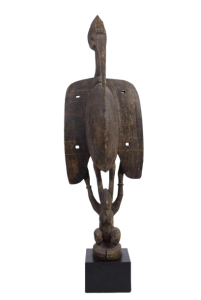
Comparative Sculpture Analysis: Consistency Across Regions and Periods
Examination of hornbill sculptures from different Senufo regions and time periods reveals remarkable formal consistency in the 'pregnant' pose, demonstrating this represents canonical knowledge transmitted through generations rather than individual artistic innovation.
View Full-Size Image