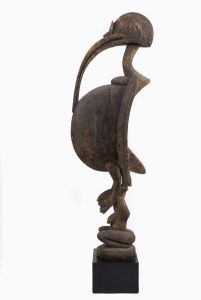
THE 'PREGNANT' FORM: ENCODING PROCREATION AND COMMUNITY CONTINUITY
Elder Interpretations: Theological Explanations of Form
Ethnographic research collecting direct testimony from Senufo religious specialists documents how communities interpret the hornbill’s distinctive form. These explanations come from elders with authority to teach sacred knowledge individuals who have completed advanced Poro initiation stages and gained recognized expertise in symbolic interpretation.
Elder Testimony (Collected Mid-20th Century):
One elder from northern Cote d’Ivoire explained:
“The bird shows how life comes to be. The beak is the man’s part, the belly is the woman’s part. When they touch, life begins. This is true for crops in the field, children in the mother, knowledge in the student. All creation follows this pattern the Porpianong shows us the pattern established at the world’s beginning.”
Another Poro elder described the symbolism this way:
“You see how the beak curves down to meet the belly? This is not how a real bird stands. The carver makes it this way to teach. The curved beak is like a man planting seed. The round belly is like the earth receiving seed, like the woman receiving the husband, like the student receiving teaching. The place where they touch this is the moment of creation. The Porpianong, being first created, shows all other creatures how to create.”
Sandogo Diviner Explanation:
A female Sandogo specialist explained the agricultural dimension:
“When we place the Porpianong at the field’s edge before planting, we remind the earth of its purpose. The bird’s belly shows the earth what it should become full, pregnant with crops. The beak touching the belly shows what the farmer must do enter the earth with his planting stick as the bird enters with its beak. The earth sees the Porpianong and remembers how to be fertile.”
Initiation Teaching:
Accounts from Poro initiates describe how the “pregnant” form is taught:
- First Stage (Poworo): Young boys learn to recognize the form and understand it means “fertility” in general terms
- Second Stage (Kwonro): Adolescents learn to create the form themselves through carving, physically encoding the knowledge in wood
- Third Stage (Tyolog): Adults learn the full theological explanation of male/female principles and the primordial creative pattern
- Fourth Stage (Kaffono): The deepest initiates learn how to actively work with this symbolism in ritual, making the creative power present and effective
This staged revelation ensures understanding deepens with maturity and spiritual preparation.
Contemporary Understanding:
Modern Senufo communities retain this interpretation even as other aspects of traditional life change. The “pregnant” hornbill remains recognizable as fertility symbol across generations, though detailed theological knowledge may be concentrated among ritual specialists rather than universally known.