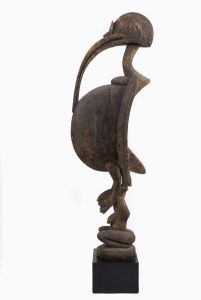
THE 'PREGNANT' FORM: ENCODING PROCREATION AND COMMUNITY CONTINUITY
Comparative Sculpture Analysis: Consistency Across Regions and Periods
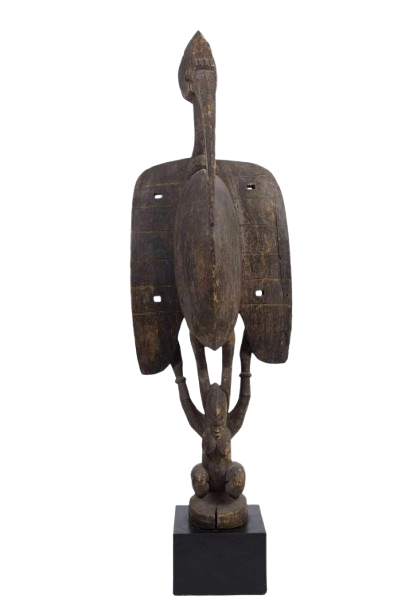
Analysis of Senufo hornbill sculptures housed in museums, private collections, and still used in ritual contexts reveals striking consistency in formal features across geographic regions and time periods. This consistency suggests the “pregnant” form represents transmitted canonical knowledge rather than artistic preference.
Museum Collections Analysis:
Metropolitan Museum of Art (New York):
- Multiple Sejen bird sculptures from northern Cote d’Ivoire
- Dating from late 19th to mid-20th century
- All display curved beak touching protruding belly
- Variations in size (18 inches to 48 inches) and surface decoration
- Core formal feature remains constant despite other differences
Yves Saint Laurent Museum (Marrakech):
- The famous 1960 Porpianong acquisition
- Origin: Burkina Faso region
- Displays canonical “pregnant” pose
- Distinguished by particularly graceful beak curve and decorated wing boards
Old Jail Art Center (Albany, Texas):
- Porpianong sculpture documented in collection
- Geographic origin and exact date uncertain
- Features same beak-touching-belly configuration
- Demonstrates pattern extends even to pieces far removed from original context
Regional Variations Within Consistency:
While the core “pregnant” form remains constant, regional variations appear in:
- Surface Decoration: Some regions favor geometric patterns on wing boards; others prefer smooth surfaces
- Color Application: Natural wood, painted surfaces, or mixed approaches vary by community
- Proportional Emphasis: Some carvers create extremely elongated beaks; others emphasize the belly’s fullness
- Scale: From small masks to monumental field guardians
But these variations occur within a framework of formal consistency regarding the essential beak-belly relationship.
Temporal Consistency:
Examination of sculptures reliably dated to different periods shows:
- Pre-Colonial Era: Limited surviving examples show the “pregnant” form was already established
- Colonial Period (1890s-1960): Form continues unchanged despite massive social disruption
- Post-Independence (1960-present): Contemporary ritual pieces and tourist reproductions both maintain the canonical pose
- 21st Century: Senufo carvers creating pieces today still employ the traditional form
This temporal consistency across 150+ years of documented examples (and likely centuries more of undocumented tradition) demonstrates the form’s status as transmitted knowledge rather than evolving aesthetic preference.
Transmission Mechanisms:
This consistency results from:
- Poro initiation teaching standardized symbolic forms
- Master-apprentice relationships in carving guilds
- Ritual requirements demanding recognizable canonical forms
- Community knowledge making “incorrect” forms unacceptable for ceremonial use
The “pregnant” hornbill isn’t an artistic innovation but preserved sacred knowledge, a form so central to Senufo spiritual understanding that it resists change even as other aspects of culture evolve.