
BLANCHE DENISE FERRERO-WILLMANN
Blanche Denise Ferrero-Willmann
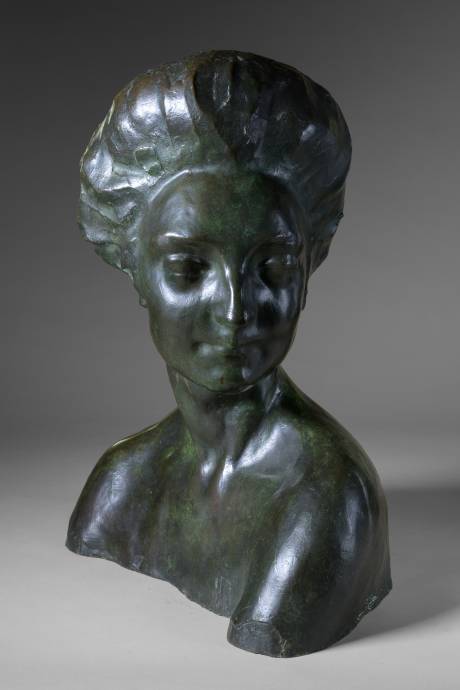
A forensic case study correcting the public story around Blanche Denise Ferrero-Willmann and Rembrandt Bugatti’s portrait bust. Later literature pushed the bronze into a generic 1920–1930 frame and reduced Blanche Denise to a sitter’s name. The source record points instead to an early 1904 portrait rooted in her Paris years, before migration to the United States in 1907.
Civil records, migration evidence, patent material, catalog excerpts, and comparison images recover Blanche Denise as the historical subject at the centre of the case and show how repetition turned a weak dating claim into accepted fact. The purpose of this dossier is to bring that misconception into view, then replace it with the strongest evidence-based reading now available.
Timeline
Filed 1930 / Granted 1931
1931
The Central Claim This Dossier Contests
Auction houses and scholarship have attached the date range 1920–1930 to the Rembrandt Bugatti portrait bust of Blanche Denise Ferrero-Willmann. That date range is not supported by the sitter’s documented biography. Blanche Denise left Paris for the United States in 1907. A portrait made between 1920 and 1930 would require either a return visit for which no evidence exists, or a posthumous casting logic that the specific object does not support.
The stronger reading, grounded in the sitter’s own chronology, places the portrait in the context of Bugatti’s early Paris years around 1904. That date aligns with Blanche Denise’s documented presence in the sculptural world through her husband Felix Jacques Ferrero, a praticien working in Rodin’s professional circle. It aligns with Bugatti’s known portrait activity in the same period. And it aligns with the visual comparison material.
Who Was Blanche Denise Ferrero-Willmann
Blanche Denise Willmann was born in Saint-Denis around 1880, daughter of Eugène Willmann and Blanche Marie Honorine Souquet. On 22 March 1898 she married Felix Jacques Ferrero in Paris. Through Felix’s work as a praticien—a skilled studio assistant responsible for enlarging and transferring sculptors’ designs—Blanche Denise was embedded in the professional world of Parisian sculpture at exactly the moment Bugatti was working in that city.
In 1907 the Ferrero family migrated to the United States. That migration is the biographical boundary that makes the 1920–1930 dating claim structurally implausible. The dossier traces what became of Blanche Denise in America: she filed US Patent 1,837,958 on 29 March 1930 and received it on 22 December 1931, recording her as inventor. That document alone transforms the conventional image of a passive sitter into a documented historical agent with an independent technical record.
Why the Misconception Spread
The 1920–1930 dating appears to have entered the literature through catalog shorthand: a broad date range applied to a class of Bugatti bronzes without case-specific verification. Once written down, that shorthand was repeated rather than re-examined. Repetition is not the same as evidence. The fact that a date appears across multiple publications does not make it correct; it may simply mean multiple publications copied the same unchecked source.
This is a pattern the Art Revisionist project documents across cases. Claims migrate from one reference to the next, acquiring apparent authority through accumulation rather than proof. The Blanche Denise case is a clear example: the sitter’s biography, which directly contradicts the late dating, was never consulted.
What the Dossier Establishes
This dossier establishes four things with the current evidence. First, Blanche Denise Ferrero-Willmann was a real, traceable historical person whose biography constrains how the bust can be dated. Second, the early Paris context around 1904 is the period most consistent with the available evidence. Third, the 1920–1930 dating is a catalog claim that has not been supported by primary source argument. Fourth, any responsible re-publication of this work should note the contested status of the later date and make the case for the earlier one.
Three questions remain open and are documented as such in the dossier: the exact birth date, the full cast-specific provenance chain, and some of the wider social connections to figures like Judith Cladel. Those gaps do not block the correction. They define the limits of what can currently be stated with certainty.
Topic Pages (5)
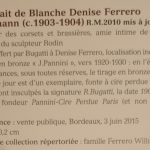
How the Case Was Misstated
The opening claim: later catalog language pushed the bust into a generic 1920-1930 frame and reduced Blanche Denise to a name instead of a historical subject.
Read the Full Study
Blanche Denise Willmann: Recovering the Sitter
Civil records, marriage evidence, migration material, and patent documents restore Blanche Denise as the historical subject at the center of the case.
Read the Full Study
How the Blanche Record Should Be Corrected
A case-led correction showing how the Blanche bust should now be described, which records support that revision, and where the dossier still remains open.
Read the Full Study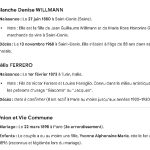
What the Literature Got Wrong
The repeated errors are now visible: Blanche Denise was reduced to a muse, and a weak later date was treated as established fact.
Read the Full Study
How the Blanche Record Should Be Corrected
A case-led correction showing how the Blanche bust should now be described, which records support that revision, and where the dossier still remains open.
Read the Full StudyFAQ Q&A