
BLANCHE DENISE FERRERO-WILLMANN
How the Case Was Misstated
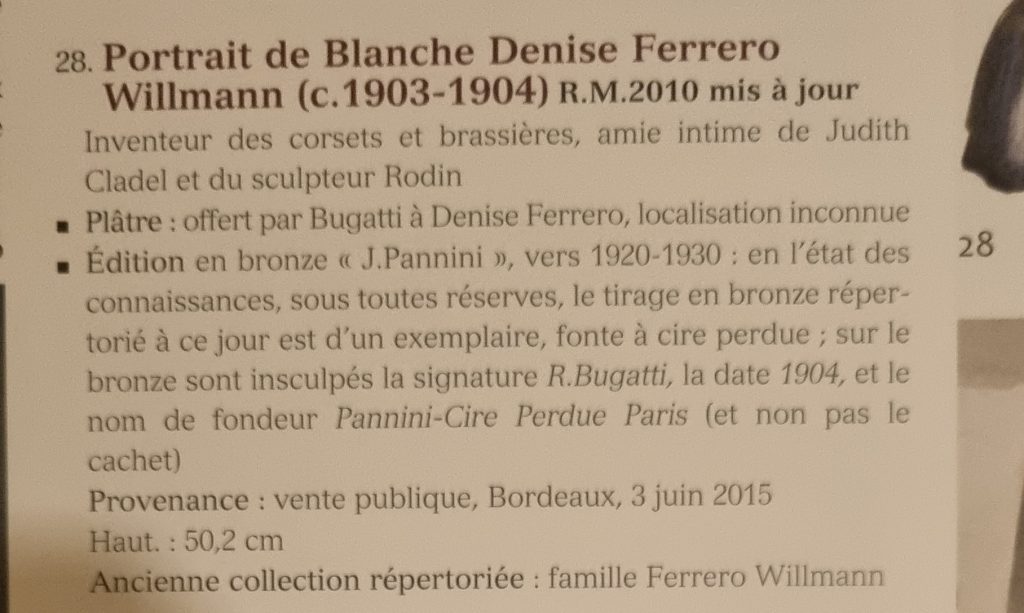
This case is not about polishing a familiar story. It is about correcting one. Over time, the portrait bust of Blanche Denise Ferrero-Willmann was pulled away from the sitter’s own chronology and absorbed into a later, weaker literature claim. Blanche Denise herself was flattened into a name, while the bust was increasingly described through generic bronze-dating language that attached numbers without argument.
The Misreading at the Centre of the Case
The critical misconception is the repeated 1920–1930 dating attached to the bronze. That range appears across auction catalogs and listing material. Stated often enough, it acquired the texture of settled fact. But it was never a case-specific conclusion reached through examination of the sitter’s biography. It was a class assignment: a date range applied to a type of Bugatti bronze without checking whether it fit the specific object and the specific person portrayed.
Once that later frame entered the literature, the portrait stopped being read as a work rooted in Blanche Denise’s Paris years and started being treated as a more remote market object. That shift has consequences. It detaches the sculpture from the social and biographical context that gives it historical meaning. It makes the sitter irrelevant. And it produces a provenance chain with a gap in it that no one has thought to notice.
The Sitter Who Was Erased
Blanche Denise Ferrero-Willmann is a traceable historical person. She was born in Saint-Denis around 1880. She married Felix Jacques Ferrero on 22 March 1898. Felix worked as a praticien in the orbit of Rodin’s studio, placing Blanche Denise inside the professional world of Parisian sculpture during exactly the period when Bugatti was active in that city. None of this biographical information appears in the published record around this bust.
Instead, she appears as a name. The bust is described as a portrait of Blanche Denise Ferrero-Willmann, and that is where the description ends. No context, no chronology, no indication of how she connected to Bugatti’s world. The biography that would directly constrain the dating of the work was not used.
How the Error Spread
The mechanism is the same one the Art Revisionist project documents across multiple cases. A claim is introduced into the literature — in this case a date range — without primary source justification. That claim is picked up by the next catalog, which treats the previous catalog as authority. The citation chain grows, but the chain leads back to an original assertion rather than original evidence.
This is what the historical record looks like when it is under-verified. A date that might have been questioned at first entry becomes, through repetition, the date. The sitter’s biography that would have answered the question was available in civil records and migration files. No one looked.
What This Research Restores
The dossier restores the case to the stronger chronology. Blanche Denise in Saint-Denis. Marriage in 1898 to a sculptor’s assistant. The portrait context around 1904 in Bugatti’s early Paris years. The family’s migration to the United States in 1907. And, critically, the US patent record of 1930–1931, which establishes Blanche Denise as an inventor — a woman with a documented technical identity that contradicts the muse narrative entirely.
The goal is simple: bring the misconception into view, then replace it with the best-supported version of the case. That is what responsible historical correction looks like. Not speculation, not rewriting, but the substitution of evidence for assumption.
What Cannot Yet Be Closed
Three points remain under investigation. The exact birth date of Blanche Denise is recorded inconsistently in available documents: 19 January 1880 and 27 June 1880 both appear, and the discrepancy needs resolution through the civil register. The full cast-specific provenance chain for this bust has not been reconstructed to a publishable standard. And certain social connections referenced in the dossier — including a possible link to Judith Cladel — need citation-grade confirmation before they can be stated in print.
Those open questions do not block the correction. They define its present limits. The correction that can be made now is firm: the 1920–1930 date is contested, the early Paris context is the stronger reading, and Blanche Denise deserves to be described as the historical person she was.
Details (2)

The Claim Under Review
The exact file set that preserves both the misconception and the correction.
Read the Full Study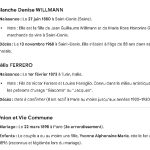
How the Case Is Tested
Primary records first, repeated catalog language second, unresolved points left open.
Read the Full Study