
BLANCHE DENISE FERRERO-WILLMANN
What the Literature Got Wrong
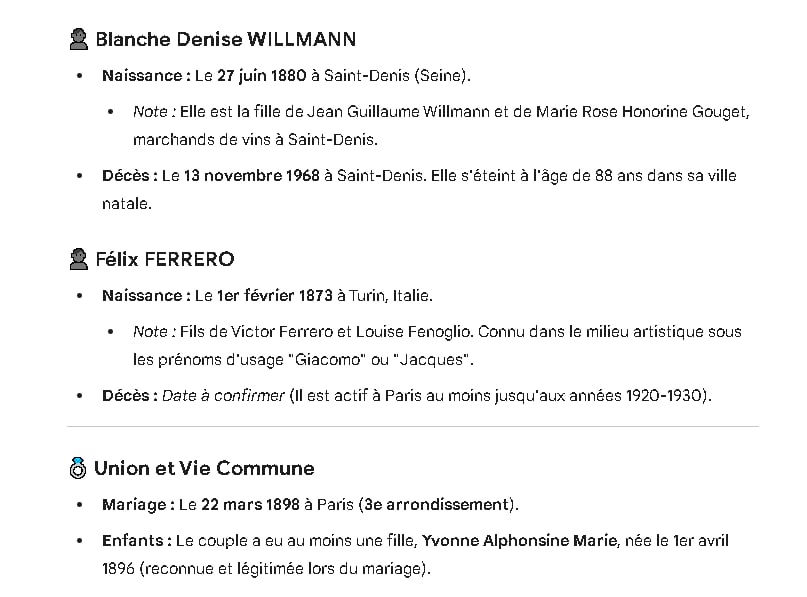
This dossier exposes two linked failures in the literature. First, Blanche Denise Ferrero-Willmann was reduced to a supporting name instead of being reconstructed as a historical person. Second, the bust was increasingly described through a 1920–1930 dating formula that now looks stronger in repetition than in evidence. Both failures have the same root: no one went back to the primary record. Both are correctable with the material now assembled.
Failure One: The Erasure of the Sitter
The conventions of auction catalog writing treat sitters for portraits in one of two ways. Either the sitter is a famous person whose name adds value, in which case their biography is cited at length. Or the sitter is unknown or peripheral, in which case they are identified by name and no more. Blanche Denise Ferrero-Willmann received the second treatment, despite being a traceable historical person with a documented biography that is directly relevant to the object’s meaning and dating.
The consequences of this erasure go beyond biographical incompleteness. When the sitter’s biography is not consulted, the dating of the work loses its most specific anchor. A bronze portrait of a real person cannot be dated responsibly without asking when that person lived in the city where the sculptor was active, and whether the claimed date is consistent with the sitter’s documented movements. None of that was asked in the existing literature. The catalog writers worked as though the sitter were a label, not a person.
Failure Two: The Unchecked Date
The 1920–1930 dating range entered the literature through a mechanism that is not unusual but is consistently dangerous: class attribution. A date range was assigned to a group of Bugatti bronzes on market-category grounds, and individual works within that group inherited the range without individual verification. That approach can produce reasonable first approximations. It cannot produce reliable case-specific conclusions.
The specific failure here is that the class attribution was not flagged as provisional when it was applied to this bust. It was stated as a conclusion. Later publications treated the conclusion as a datum. The citation chain grew until the date appeared to be supported by multiple sources, when in reality those sources shared a single unverified origin.
What the Literature Missed
Civil birth records place Blanche Denise in Saint-Denis around 1880. Marriage records place her in Paris in 1898, married to a praticien connected to Rodin’s studio. Migration records confirm the family’s departure to the United States in 1907. US Patent 1,837,958 records her as an inventor in 1930–1931. None of these documents is obscure. All were available for consultation. The literature simply did not look.
The comparison material for Bugatti’s portrait work in the early 1900s was similarly available. Stylistic analysis of this bust against dated works from his Paris period supports the 1904 reading. The literature did not engage with this analysis because it had already assigned a date on non-stylistic grounds and treated that assignment as sufficient.
Corrections Supported Now
The present dossier supports several public corrections that can be made without waiting for further archival work. Blanche Denise’s biography can be stated accurately: born Saint-Denis around 1880, married Felix Jacques Ferrero 1898, Paris-connected through the sculptural world, migrated to the United States 1907, inventor on US patent record 1930–1931. The early Paris context for the bust — around 1904 — should be given priority over the 1920–1930 range as the best current interpretation. Any catalog entry for this work should note that the later dating is contested.
What Still Needs Proof
Three points remain open and are documented as open. The exact birth date has two conflicting records and needs civil register verification. The cast-specific provenance chain for this bronze has not been reconstructed to a publishable standard. And references to social connections beyond the Ferrero-Bugatti link — including a possible association with Judith Cladel — need citation-grade confirmation before they enter the public argument. None of these gaps invalidates the correction that can currently be made. They define its current limits.
The Standard the Literature Should Meet
A portrait bronze of a named sitter should be treated as a biographical document as well as an art object. The sitter’s life constrains the dating. The social connections place the work in context. The migration history sets the window within which a life sitting was possible. None of this requires extraordinary archival effort. It requires the decision to treat the sitter as a person rather than a label. That decision was not made in the existing literature. It is being made here.
Details (2)

Corrections Supported by the Record
The claims that can already be stated directly in public-facing scholarship.
Read the Full Study
Questions Still Open
The remaining archival tasks that should stay visible in any responsible correction.
Read the Full Study