
Sacred Knowledge in Carved Wood: The Poro Initiation and Senufo Art
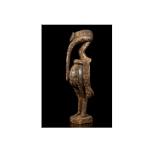
In the dense forests of West Africa, far from the gaze of outsiders, the Poro initiation society has shaped the spiritual, social, and artistic life of the Senufo people for centuries. It is within this secretive institution that some of Africa’s most powerful art was created — not as decoration, but as vessels of sacred knowledge.
Years of Spiritual Education
The Poro is not a ceremony — it is a curriculum. Young men enter as children and emerge, decades later, as fully initiated members of Senufo society. Throughout this process, knowledge is transmitted through symbolic language embedded in carved figures, masks, and ritual objects.
Every element of a Senufo hornbill sculpture carries encoded meaning: proportions teach cosmological principles, surface textures reference agricultural cycles, and the overall form embodies the creation mythology that underpins Senufo worldview.
Masks and Ancestral Guidance
Among the most powerful objects in the Poro repertoire are the Kponyungo firespitter masks — composite creatures that channel ancestral spirits during initiation ceremonies. These are not performances in the Western theatrical sense; they are encounters with the invisible world, mediated through carved and painted forms.
The connection between the hornbill and elder knowledge is central to understanding why this particular bird was chosen as such a powerful symbol. In Senufo thought, intellectual prowess — the ability to see connections between the visible and invisible — is the highest form of human achievement.
Tradition Under Pressure
Today, the Poro system faces unprecedented challenges from Islam, Christianity, and modernization. As traditional knowledge systems erode, the objects that once served as teaching tools become “art” — stripped of context, displayed in Western museums, and admired for qualities that were never the point.
As we explored in our earlier post on the Senufo hornbill’s sacred significance, and as we’ll examine further when we discuss the journey from sacred grove to Western gallery, this transformation raises profound questions about cultural ownership, context, and meaning.
The village structure and geographic distribution of Senufo communities continue to shape how these traditions survive — or don’t — in the modern world.
Frequently Asked Questions
What is the significance of the Poro initiation in Senufo culture?
The Poro initiation is a comprehensive spiritual education system in Senufo culture, where young men undergo decades of training to become fully initiated members of society. It involves the transmission of sacred knowledge through symbolic carvings and ritual objects.
Why is the hornbill a significant symbol in Senufo art?
In Senufo culture, the hornbill symbolizes intellectual prowess and elder knowledge. Its form in sculptures represents cosmological principles and agricultural cycles, embodying the creation mythology that is central to Senufo worldview.
How do Kponyungo firespitter masks function in Senufo ceremonies?
Kponyungo firespitter masks are used in Senufo initiation ceremonies to channel ancestral spirits. These masks are not merely theatrical but serve as a medium for encountering the invisible world through artful expressions.
What challenges does the Poro system face today?
The Poro system faces challenges from the spread of Islam, Christianity, and modernization, leading to the erosion of traditional knowledge systems. As a result, sacred objects are often recontextualized as 'art' in Western museums, losing their original cultural significance.
How does the transformation of Senufo art into museum pieces affect its cultural meaning?
When Senufo art is displayed in Western museums, it is often stripped of its original context and sacred function, leading to a shift in perception from a vessel of sacred knowledge to an aesthetic object, raising questions about cultural ownership and meaning.
Leave a Reply