
BLANCHE DENISE FERRERO-WILLMANN
Blanche Denise Willmann: Recovering the Sitter
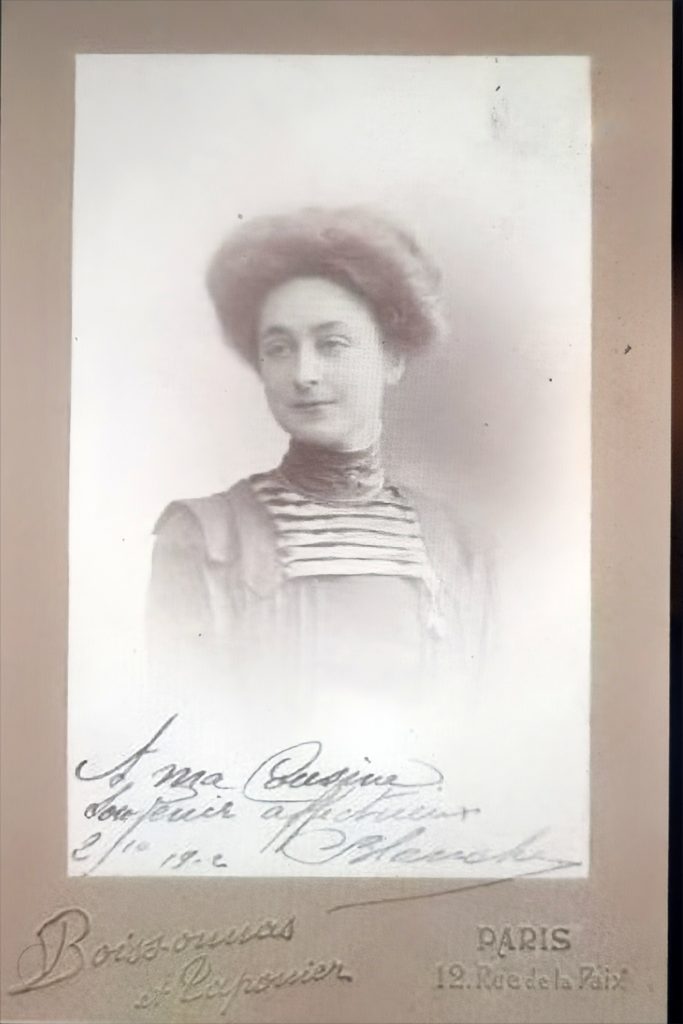
The first correction is biographical. Blanche Denise Ferrero-Willmann should not appear in Bugatti scholarship as a decorative sitter with no life beyond the bust. The dossier shows that she can be placed within a documented chronology of family, marriage, migration, and independent work. She is a recoverable historical person, and that recovery changes how the portrait must be read.
Origins and Early Life
Blanche Denise Willmann was born in Saint-Denis, the industrial commune immediately north of Paris, around 1880. Her father was Eugène Willmann and her mother was Blanche Marie Honorine Souquet. Two dates appear in the available documents — 19 January 1880 and 27 June 1880 — and the discrepancy has not yet been resolved against the original civil register. That detail remains under investigation. What is not in dispute is that Blanche Denise grew up in the greater Paris area and was part of the social milieu connected to the city’s artistic trades.
Marriage Into the Sculptural World
On 22 March 1898, Blanche Denise Willmann married Felix Jacques Ferrero in Paris. That marriage is the biographical fact that places her inside the professional world of Parisian sculpture. Felix worked as a praticien — a skilled studio collaborator whose role was to enlarge and transfer sculptors’ designs from maquette to full-scale work. Praticiens were essential to the operation of major studios, including Rodin’s, and Felix Ferrero’s connection to that orbit is documented.
Working as a praticien meant Felix was embedded in the networks of foundries, studios, and artist relationships that defined Parisian sculpture in the years around 1900. Through that connection, Blanche Denise had access to exactly the social world from which Rembrandt Bugatti’s portrait subjects were drawn. The claim that the bust was a chance commission or a remote market transaction becomes harder to sustain once the Ferrero household’s position in that milieu is understood.
The Portrait and Its Context
Rembrandt Bugatti was active in Paris in the early years of the twentieth century before relocating to Antwerp in 1906. His known portrait work of this period reflects the social circles he moved in: artists, their families, their associates. The correspondence between the Ferrero social world and Bugatti’s portrait subjects in this period supports the dossier’s dating argument: the bust belongs to the early Paris phase, not to a later decade.
By 1904, Bugatti had established his reputation as one of the most gifted young sculptors in Paris. A portrait commission from someone within the professional sculptural community — through a praticien husband with studio connections — fits the pattern of his documented sitters at this time. That context is invisible in the current literature because Blanche Denise is presented as a name rather than a person.
Migration to the United States
In 1907, the Ferrero family migrated to the United States. This is the chronological boundary the dossier uses to contest the later dating. No evidence of a return to Paris for a portrait sitting has been found. The migration was not a temporary relocation: Blanche Denise’s subsequent American record shows a life built on the other side of the Atlantic, not structured around European visits.
Beyond the Muse: The Patent Record
The move to the United States and the later patent record change the shape of Blanche Denise’s biography entirely. US Patent 1,837,958, filed on 29 March 1930 and issued on 22 December 1931, records B. D. Ferrero née Willmann as inventor. The full subject of the patent has not yet been published in this dossier, but the document is decisive: Blanche Denise did not disappear after posing for a sculptor. She built a working life in America that left an independent trace in the technical record.
That document transforms the conventional reading of the portrait. The muse who was memorialised in bronze turns out to have been an independent intellectual agent who filed patents under her own name thirty years after the portrait was made. That is not the biography of a decorative figure. It is the biography of a person the art historical literature has not yet chosen to reconstruct.
Why the Recovery Matters
The recovery of Blanche Denise’s biography is not a footnote to the dating argument. It is part of the argument. Once the sitter has a documented life — once she has a place of birth, a marriage, a social world, a migration, and a patent — the bust must be read differently. It becomes a portrait of a specific person at a specific moment in a specific world. The generic dating claim, which required treating her as an undifferentiated name, becomes correspondingly harder to defend.
Details (2)

Birth, Family, and Marriage
The civil and family record that anchors Blanche Denise in place, date, and kinship.
Read the Full Study
Migration and Patent Record
The U.S. evidence that restores Blanche Denise as an independent actor, not only a sitter.
Read the Full Study