
BLANCHE DENISE WILLMANN: RECOVERING THE SITTER
Migration and Patent Record
In 1907 the Ferrero family migrated to the United States. This migration is the single most important biographical datum for the dating argument. It establishes a hard biographical boundary: from 1907 onward, Blanche Denise Ferrero-Willmann was no longer resident in Paris. Any portrait of her made in Paris would therefore need to predate 1907.
Immigration records confirm the family’s arrival in the United States. The FamilySearch and Ellis Island databases contain material consistent with this migration timeline. The records document the transition from French to American residence and support the reconstruction of the family’s trajectory across the Atlantic.
The significance of the migration is direct and arithmetical: the 1920–1930 date range attributed to the Bugatti bust requires Blanche Denise to have been in Paris between 1920 and 1930. No evidence supports a return visit during that period. The 1907 departure is therefore not a peripheral biographical fact. It is a falsifying condition for the published date range.
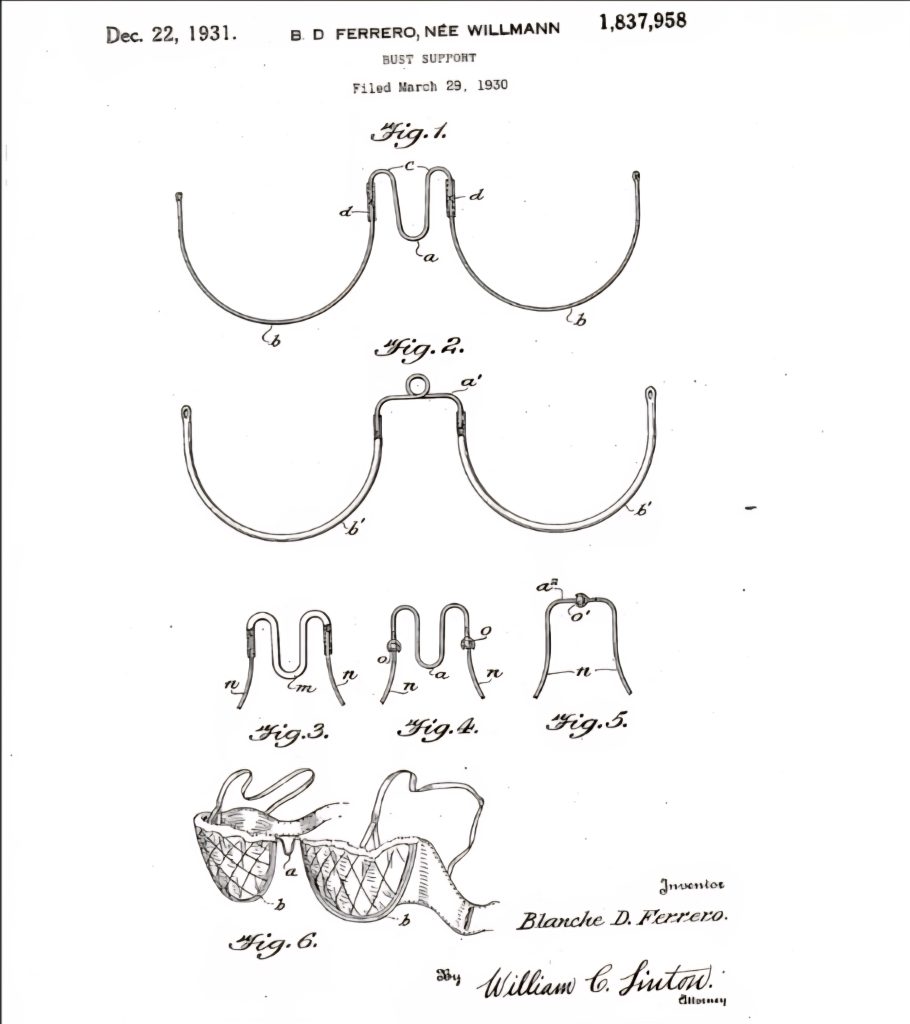
The patent record adds a further dimension. US Patent 1,837,958, filed on 29 March 1930 and granted on 22 December 1931, names B. D. Ferrero nee Willmann as inventor. The patent describes an innovation in fashion support technology. Its significance for this dossier is twofold: it confirms Blanche Denise’s continued presence and professional activity in the United States decades after the migration, and it transforms her historical profile. She is not a passive sitter whose name appears on a bronze. She is a documented historical agent with an independent professional record — a person who invented, filed, and received a patent under her own name.
Evidence

Migration Record: US Arrival Documentation
Migration evidence tied to 1907 timeline claims.
View Full-Size Image US Patent 1,837,958 — B. D. Ferrero, Inventor
Primary proof of independent technical contribution.
View Full-Size Image