
VALSUANI BRONZE AUTHENTICATION
Contemporary Newspaper Articles
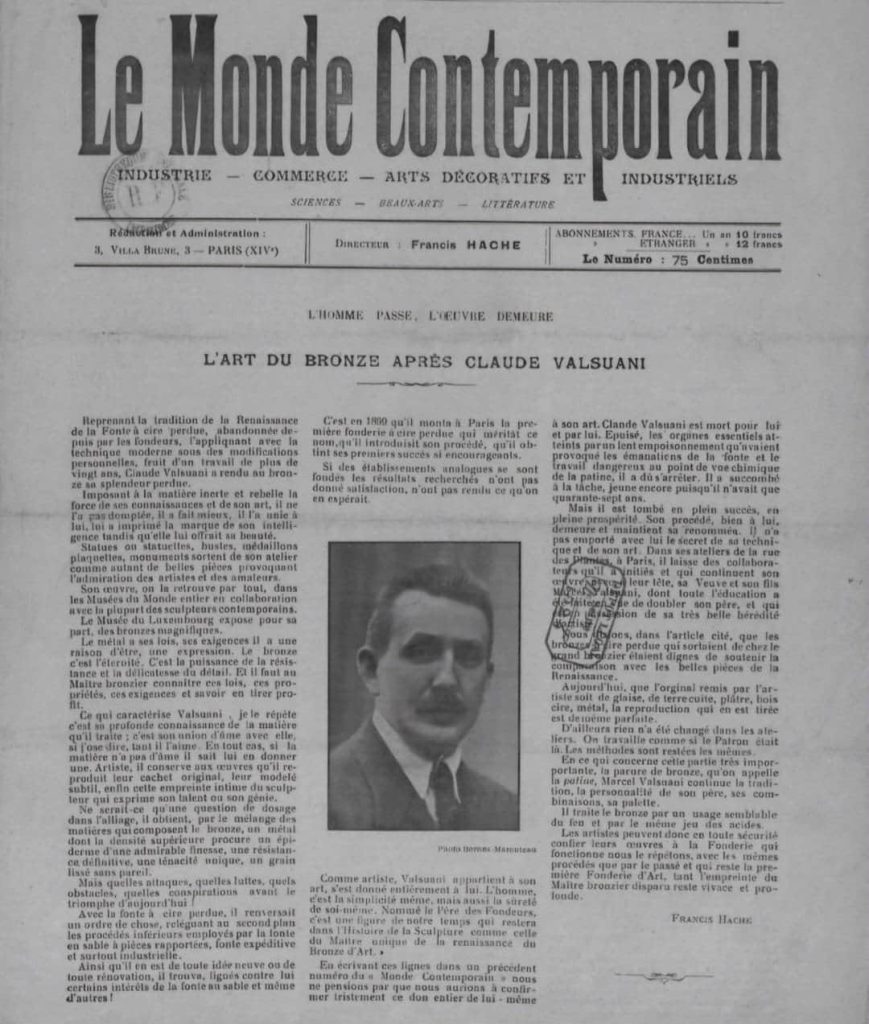
Contemporary newspaper coverage provides crucial evidence precisely because it was produced when individuals with direct knowledge of Claude Valsuani were still alive to verify or contest factual claims.
Publication Details
- Publication: Le Monde Contemporain
- Title: “L’Art du Bronze Après Claude Valsuani” (The Art of Bronze After Claude Valsuani)
- Date: Circa 1923 (following Claude’s death)
Key Quotation
“C’est en 1890 qu’il monta à Paris la première fonderie à cire perdue”
Translation: “It was in 1890 that he set up the first lost-wax foundry in Paris”
Evidential Analysis
This contemporary source provides multiple confirmations:
- Names Claude specifically: Not Marcello, not Carlo, not any predecessor
- Credits him with founding the foundry: “il monta” (he set up)
- Contains a dating error: its “1890” is impossible. Claude only arrived in Paris in 1899 and founded the foundry in 1908 (letterhead: “FONDEE EN 1908”). The identification of Claude as founder stands; the date does not
- Written shortly after Claude’s death: When facts remained within living memory
- Contains no mention of Marcello: Despite being a natural context for acknowledging a founder or patriarch
The Value of Contemporaneous Sources
Contemporary sources carry special evidentiary weight because:
- Errors would be noticed and corrected by living witnesses
- They predate the mythology that developed in later decades
- Writers had access to direct knowledge and personal testimony
- They had no agenda regarding historical debates that had not yet emerged
The complete absence of “Marcello” in contemporary press coverage strongly indicates he simply did not exist. If any patriarch or founder preceded Claude, obituary-era journalism would naturally have acknowledged this lineage.
-192x300.jpeg)