FROM SACRED GROVE TO WESTERN GALLERY: CULTURAL TRANSLATION AND LOSS
Yves Saint Laurent’s Collection: High Fashion Meets Sacred Art
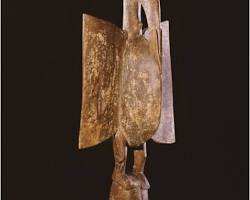
In 1960, fashion designers Yves Saint Laurent and Pierre Berge made their first art acquisition: a Senufo Porpianong hornbill sculpture. This purchase inaugurated what would become one of the 20th century’s most celebrated private art collections, and provides a case study in how Western cultural figures engage with African sacred art.
The Acquisition
Historical Context: 1960 marked a pivotal moment both for Saint Laurent (recently assuming leadership of Christian Dior) and for African art markets (as newly independent West African nations grappled with colonial legacies and economic pressures).
First Purchase Significance: Of all possible artworks, Saint Laurent chose a Senufo hornbill as his inaugural acquisition. This choice suggests genuine aesthetic response to the form’s power and presence.
Market Context: The sculpture likely reached Saint Laurent through Parisian dealers specializing in African art, part of the flood of Senufo pieces entering Western markets during the mid-20th century.
Display and Function: Saint Laurent kept the sculpture in personal living spaces rather than museum-like isolation, treating it as both art object and design inspiration.
Influence on Design Work
Saint Laurent drew inspiration from African art throughout his career:
Direct African Collections:
- 1967 collection inspired by Bambara art following first Marrakech trip
- Multiple collections incorporating African motifs, textiles, aesthetic principles
- Ongoing African art collecting that filled Paris apartment and later museum
Hornbill’s Subtle Influence:
The Porpianong’s impact appears less in direct quotation than in aesthetic principles:
- Elongated Silhouettes: Saint Laurent’s signature sleek vertical forms echo the hornbill’s elongated body
- Geometric Simplification: The bird’s stylization parallels Saint Laurent’s refined minimalism
- Sculptural Garment Construction: Clothes as three-dimensional forms rather than mere fabric
- Presence and Gravitas: The sculpture’s dignified bearing resonates with Saint Laurent’s elegant restraint
Post-Death Disposition
Following Saint Laurent’s 2008 death, Pierre Berge organized a major Christie’s auction of the collection. Berge chose to keep the Senufo hornbill rather than sell it, retaining the very first piece acquired.
This decision suggests:
- Enduring personal significance beyond monetary value
- Recognition of the object’s symbolic role in their collecting journey
- Emotional attachment transcending aesthetic or investment considerations
The sculpture now resides at the Yves Saint Laurent Museum in Marrakech, displayed prominently as testament to the designer’s refined taste and African art appreciation.
What This Acquisition Represents
Saint Laurent’s engagement with the Senufo hornbill embodies contradictions:
Genuine Aesthetic Appreciation:
- Recognized the form’s power, beauty, spiritual gravitas
- Responded to qualities that Senufo carvers deliberately encoded
- Maintained lifelong engagement with African art traditions
Cultural Decontextualization:
- Acquisition divorced object from ritual function
- Became collectible rather than tool for divine connection
- Moved from community spiritual asset to private possession
- Economic transformation: spiritual technology → global art market commodity
Asymmetrical Knowledge:
- Saint Laurent knew sophisticated formal analysis, art historical context, aesthetic theory
- Likely knew little about Poro initiation, Sandogo divination, funeral rites, agricultural ceremonies
- Responded powerfully to what he could see; remained ignorant of what required initiation to understand
Power Dynamics:
- French designer’s purchasing power accessing Senufo sacred objects
- Economic pressures making such sales attractive or necessary
- Western institutional frameworks (museums, auction houses, art criticism) valorizing African art while marginalizing African knowledge systems
The Museum Display
The YSL Museum’s prominent display of the Porpianong tells a specific story:
- Celebrates Saint Laurent’s discernment and refined taste
- Demonstrates Western “discovery” of African art’s aesthetic value
- Makes visible the designer’s cosmopolitan cultural engagement
But this same display obscures:
- The sculpture’s original spiritual function
- Circumstances under which it left its cultural context
- Living Senufo communities’ perspectives on sacred object commodification
- Power imbalances enabling Western collectors to possess African sacred art
The museum presents the acquisition as triumph of aesthetic appreciation. A Senufo perspective might view it as cultural loss, ritual object transformed into decoration, spiritual technology repurposed for interior design inspiration.